Notice

Please note that all content (photographs and text) are copyright of the author.
Showing posts with label Magnolias. Show all posts

Saturday, 18 April 2015

Magnolias and Cherry Trees in Hyde Park

In April I went to London to visit some friends for Easter Sunday Lunch and the Massacre of Golden Chocolate Bunnies. On the way I had to make my way through Hyde Park which had some flower beds.

While I'd expected to see more flowers Hyde Park seemed more about vast expanses of lawn with numerous paths and a scattering of trees. Given the size of Hyde Park and how I was trying to navigate across it using Google maps I suppose that impression may be mistaken. On top of that Google maps could not quite make up its mind as to where exactly I was which led me to taking me by a circuitous route instead of the straight bee line to the spot I wanted to get too did not help.

Nevertheless I did get to see some interesting sights which included a stream and small waterfall and some Mangolias and Cherry Trees.

I wanted to take a bit more time to explore and take pictures but was not sure how long it would take me to get across Hyde Park let alone find and navigate the streets and alleys I had to to get to my destination.
As it was, thanks to Goggle maps's uncertainty it was a good thing I did not linger. One area that I had hope to see were the lilies in the Italian Garden but they were empty when I passed them as the water lilies were no doubt still dormant.
Cherry Tree in Hyde Park
Hopefully I will be able to arrange another visit to London during the Waterlily blooming period. Well ... considering that I have yet to visit Kew Gardens that is something to add to my list of things to do.


 Binomial Name: Magnolia
Common names: Magnolia (English); (French); (Samoan); 

Taxonomic hierarchy: 

Kingdom: Plantae - Plants
Subkingdom: Viridaeplantae – Green plants
Infrakingdom: Streptophyta – Land plants
Superdivision: Embryophytea – 
Division: Tracheophyta – Vascular plants, tracheophytes
Subdivision: Spermatophytina – Spermatophytes (seed plants)
Infradivision: Angiospermae – Angiosperms (flowering plants)
Class: Magnoliopsida – Diocotyledons
Superorder: Magnolianae –
Order: Magnoliales –
Family: Magnoliaceae – 
Genus: Magnolia – 
Species: Magnolia 


Notes: 
  • I am using the taxonomical classification system used by ITIS (Intergrated Taxonomic Information System). I have decided to use this system in order to avoid confusion as well as because it offers a comprehensive hierarchy from kingdom right through to subspecies whereas other sources only go as far as order or  provide the names of some of the higher taxonomical ranks but only indicate "unclassified" rather than providing the rank.
  • When and where possible I will endeavour to include alternatives classifications although  I may limit this to occasions where an opportunity arises to discuss the reason for the different classifications.
  • Taxonomical data used in this post was retrieved [April 15 2015], from the Integrated Taxonomic Information System on-line database, http://www.itis.gov.

References:

Books:


On-line sources:

  • Integrated Taxonomic Information System: Entry for Magnolia
  • Integrated Taxonomic Information System: Entry for Magnoliaceae
  • United States Department of Agriculture: Entry for
  • The Plant List: Entry for
  • University of Tennessee Herbarium Entry for

  • Texas A & M University: Entry for
  • Missouri Botanical Garden: Entry for

  • Dave's Garden Entry for
  • Wikipedia: Entry for Magnolia
  • Wikipedia: Entry for Magnoliaceae
  • Wikipedia: Entry for

Flora and Fauna - Plants and Critters Blog by Vincent Albert Vermeulen is licensed under a Creative Commons Attribution-NonCommercial-ShareAlike 3.0 Unported License.

Based on a work at http://plantsandcritters.blogspot.be/.

Permissions beyond the scope of this license may be available at http://plantsandcritters.blogspot.be/.

My other blogs
· Flora and Fauna - Plants and Critters (on plants, animals as well as gardening, conservation and environmental matters): http://plantsandcritters.blogspot.com/
· The Blood of Souls (language, translation and etymology) : http://thebloodofsouls.blogspot.com/


· Whiskers on Kittens (Life with Kittens and Cats in general) : http://whiskersonkittens-vincent.blogspot.com/

Thursday, 16 April 2015

Magnolias in Fort Royal Gardens Bristol

Last week I decided that since I was going to be in the area that I would make a quick visit to the Fort Royal Gardens. I knew that I would have missed the fine display of crocuses and some of the earlier Spring flowers but hope that the Magnolias at least would still be in bloom.

Magnolia cylindrica in Fort Royal Gardens, Bristol, England

As you can see, I was not disappointed. As I came down the footpath from Fort Royal House I spied the blooms of one of the two Magnolias through a window of vegetation. Then, instead of continuing down the path I went left up a path that had previously been cordoned off, which led to an overlook of the small enclosure below the curtain wall that runs along one length of the enclosure that the two Magnolias are found. There I had a great view of the smaller Magnolia and a Cherry tree with white blooms which was on the street outside of the Gardens themselves. I'd never seen the Cherry tree because when you are inside the Gardens the boundary walls are too high and you have to walk through the small rear door / gate to see it.
Magnolia stellata in Fort Royal Gardens, Bristol, England

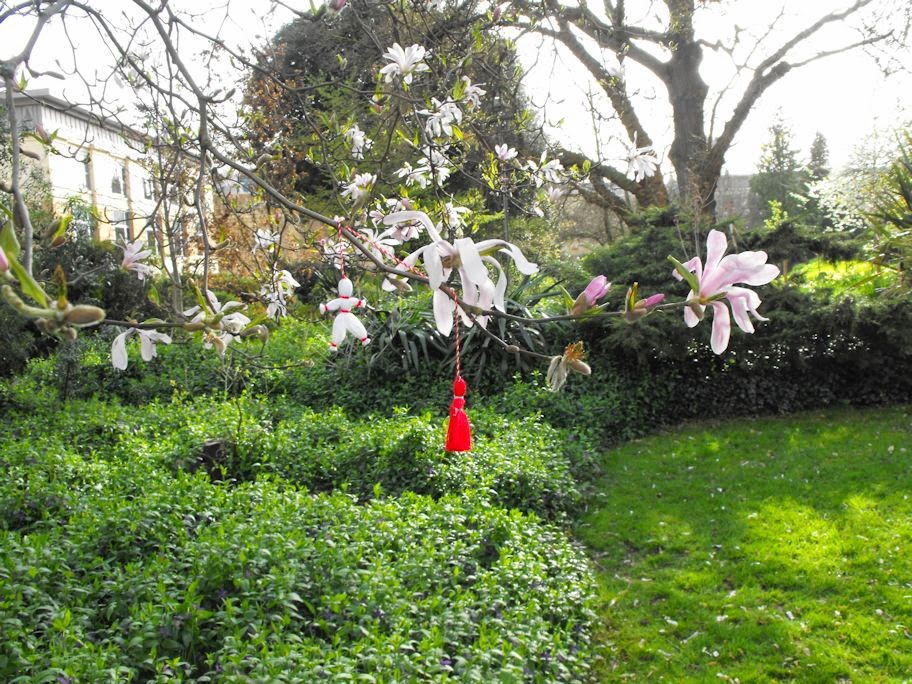
Last year in March I saw two Baba Mama Martenitsa Dolls hanging from its branches. I did not see any this time. Either the person or people who hung them up there last time were no longer in Bristol or the dolls had been taken down already. If you want to know more about them click on the link to my previous post on them.
Magnolia stellata in Fort Royal Gardens, Bristol, England
Here (below) is the bigger tree although in truth it is not that much bigger although its flowers certainly are much bigger.

Magnolia cylindrica in Fort Royal Gardens, Bristol, England


The ground below the bigger Magnolia was already strewn with fallen petals so I am glad I did not leave it too late to visit the gardens because I might have missed them altogether. I think that they will still be in bloom for another few weeks given that there were still a lot of flower buds developing. But, the thing about Magnolias is that when they are in bloom, they are worth visiting over and over again. That is unless you are lucky and have one in your garden or in a neighbors garden, which you can admire.
In Brussels there is one right across the street. There is also another one which is in a garden adjacent to Tillens Block. I have seen several other Magnolias throughout Bristol and hope that I will be able to take photos of the to show you the different colours and shapes.

Flowers of Magnolia cylindrica in Fort Royal Gardens, Bristol, England
The thing with some flowers is that sometimes even after their petals fall off or they dry up, they still somehow manage to look beautiful and or intriguing. If you want to see more Magnolias, scroll down to the Labels (on the right hand side) and look for Magnolia. That should take you to all the current posts that have Magnolias in them.

Close up of flower that has lost all its petals. Magnolia cylindrica in Fort Royal Gardens, Bristol, England
From what I have been able to find on line it appears that the smaller tree is a Magnolia stellata (although it might be a Magnolia x loebneri "Leonard Messel" AGM, which is a hybrid of Magnolia stellata and Magnolia Kobus which was created by Max Löbner.
The other one looks like Magnolia cylindrica although I'm not sure anymore after seeing other photos that show different looking flowers and fruit (which I never saw on this tree). However, it the flowers look a lot like the ones on the Missouri Botanical gardens website so i am going to assume that this is correct and that I just have never seen the fruit. Also it is a species in threat of extinction and listed on the IUCN Red List of threatened species. this is due to habitat loss in the Huang-Shan mountain range in Anhui Province, China.

Binomial Name: Magnolia cylindrica
Common names: Huang-Shan Magnolia (English);


Binomial Name: Magnolia stellata
Common names: Star Magnolia (English); Magnolia étoilé (French); Magnolia estrellada (Spanish); Stern-Magnolie (German); Magnolia stellata (Italian)
 
 Binomial Name: Magnolia kobus
Common names: Kobushi Magnolia (English); Magnolia de Kobé (French); Magnolia kobus, Magnolia del Norte del Japón (Spanish); Kobushi-Magnolien (German); Magnolia stellata (Italian)
Taxonomic hierarchy: 

Kingdom: Plantae - Plants
Subkingdom: Viridaeplantae – Green plants
Infrakingdom: Streptophyta – Land plants
Superdivision: Embryophytea – 
Division: Tracheophyta – Vascular plants, tracheophytes
Subdivision: Spermatophytina – Spermatophytes (seed plants)
Infradivision: Angiospermae – Angiosperms (flowering plants)
Class: Magnoliopsida – Diocotyledons
Superorder: Magnolianae –
Order: Magnoliales –
Family: Magnoliaceae – 
Genus: Magnolia – 
Species: Magnolia 


Notes: 
  • I am using the taxonomical classification system used by ITIS (Intergrated Taxonomic Information System). I have decided to use this system in order to avoid confusion as well as because it offers a comprehensive hierarchy from kingdom right through to subspecies whereas other sources only go as far as order or  provide the names of some of the higher taxonomical ranks but only indicate "unclassified" rather than providing the rank.
  • When and where possible I will endeavour to include alternatives classifications although  I may limit this to occasions where an opportunity arises to discuss the reason for the different classifications.
  • Taxonomical data used in this post was retrieved [April 16 2015], from the Integrated Taxonomic Information System on-line database, http://www.itis.gov.

References:

Books:


On-line sources:


Flora and Fauna - Plants and Critters Blog by Vincent Albert Vermeulen is licensed under a Creative Commons Attribution-NonCommercial-ShareAlike 3.0 Unported License.

Based on a work at http://plantsandcritters.blogspot.be/.

Permissions beyond the scope of this license may be available at http://plantsandcritters.blogspot.be/.

My other blogs
· Flora and Fauna - Plants and Critters (on plants, animals as well as gardening, conservation and environmental matters): http://plantsandcritters.blogspot.com/
· The Blood of Souls (language, translation and etymology) : http://thebloodofsouls.blogspot.com/


· Whiskers on Kittens (Life with Kittens and Cats in general) : http://whiskersonkittens-vincent.blogspot.com/

Saturday, 17 May 2014

Baba Marta Martenitsa Dolls appear in Bristol

Early this spring when I went to the Fort Royal Gardens to take some photos of the Magnolias I came across some dolls hanging from one of the Magnolia trees. Actually I would not have realised that they were there if I had not overheard one of the two guys who were there before me draw his friend's attention to them.
When I'd arrived two Japanese ladies had been leaving and I thought maybe the dolls were left by them. But when I got back and did some research, while I did find lots of Japanese dolls and stuff related to the Cherry Festival none resembled the ones I saw.
So I did a bit more digging and sifting and came across information which pointed at these dolls being Baba Marta Martenitsa Dolls.
Baba Marta is a Bulgarian holiday celebrated on the 1st of March. Baba Marta means Grandma March and has a lot of folklore related to it and the character Baba Marta who is associated with Spring. It is considered one of the oldest existing traditions in Europe having pagan origins.
As with most Spring traditions it is associated with life and rebirth as well as celebrating life and survival.
People wear small ornaments made of white and red yarn. The two Martenitsa dolls are called Pizho and Penda. Pizho who is predominantly white is male while Penda who is predominantly red is female and has a skirt. White represents purity while red symbolises life and passion.


According to tradition you cannot buy martenitsi for yourself. They have to be received as a gift. People give them to loved ones, family and friends to whom you feel close too.  You wear by pinning it to clothing or hanging it around your wrist or your neck. Martenitsa are worn until you see a stork, swallow or a budding tree which mark the beginning of spring
The ritual of taking them off is different in different parts of Bulgaria. However, some people will tie it to a tree which impart health and luck to the tree, which accounts for these two ending up on the Magnolia tree. Other rituals involve putting the Martenitsa under a stone and the belief is that the type of creature that comes closest to it the next day will determine your health in the coming year. A larva or worm denote health and success. If it is an ant the same applies except you will need to work hard to achieve that.
Similar traditions are held with in the region extending through Albania, Romania, Moldova, The Republic of Macedonia and Northern Greece


Flora and Fauna - Plants and Critters Blog by Vincent Albert Vermeulen is licensed under a Creative Commons Attribution-NonCommercial-ShareAlike 3.0 Unported License.

Based on a work at http://plantsandcritters.blogspot.be/.

Permissions beyond the scope of this license may be available at http://plantsandcritters.blogspot.be/.

My other blogs
· Flora and Fauna - Plants and Critters (on plants, animals as well as gardening, conservation and environmental matters): http://plantsandcritters.blogspot.com/
· The Blood of Souls (language, translation and etymology) : http://thebloodofsouls.blogspot.com/
· Whiskers on Kittens (Life with Kittens and Cats in general) : http://whiskersonkittens-vincent.blogspot.com/


Wednesday, 16 April 2014

more Magnolias

Sometimes it is fascinating the various shades of blue you can find in the sky. Just by moving a bit and taking a photo from a different angle or location you can get a different blue tone although the angle of the sunlight and where you are can also make a big difference as you can see here.


Magnolias with the University of Bristol Physics Building in the background


Flora and Fauna - Plants and Critters Blog by Vincent Albert Vermeulen is licensed under a Creative Commons Attribution-NonCommercial-ShareAlike 3.0 Unported License.

Based on a work at http://plantsandcritters.blogspot.be/.

Permissions beyond the scope of this license may be available at http://plantsandcritters.blogspot.be/.

My other blogs
· Flora and Fauna - Plants and Critters (on plants, animals as well as gardening, conservation and environmental matters): http://plantsandcritters.blogspot.com/
· The Blood of Souls (language, translation and etymology) : http://thebloodofsouls.blogspot.com/
· Whiskers on Kittens (Life with Kittens and Cats in general) : http://whiskersonkittens-vincent.blogspot.com/

Magnolias and Martenista dolls from Bulgaria

I was waiting for nice blue skies to coincide with when I had a bit of time to quickly go and take some more photos in the Fort Royal Gardens because I wanted to get some photos of the Cherry and Magnolia blossoms as well as the changing flora. The hard thing was finding the time since despite what people may say and think you do get to see a lot of blue skies in England. Maybe I  just notice it more than those who only notice grey skies when they are there.
Anyway here are some photos of the two Magnolia trees located in the little cul-de-sac near the rear exit of the Gardens along with some other flowers.

Magnolia Blossom that has lost all its leaves in foreground

As you can see I probably was lucky as the flowers are beginning to lose their petals which made for some interesting photo opportunities also.

I am still not sure if the smaller tree is indeed a Magnolia or not.


Some one had hung two tiny dolls on this tree. I was not sure of the symbolism but assumed it was some Japanese tradition because I had seen two Japanese girls leaving there as I arrived. In fact I only noticed it because two guys who were already there (also taking pictures along with this other lady) noticed the dolls which were hanging from the lower branches.
I looked it up and it turns out they are most likely Pizho and Penda a pair of Martenitsa dolls, which are from a Bulgarian traditional holiday Baba Marta. I'll write more in another post with a close up of the dolls.
You can go to that post by licking on the link: Baba Marta Martenitsa Dolls appear in Bristol


Flora and Fauna - Plants and Critters Blog by Vincent Albert Vermeulen is licensed under a Creative Commons Attribution-NonCommercial-ShareAlike 3.0 Unported License.

Based on a work at http://plantsandcritters.blogspot.be/.

Permissions beyond the scope of this license may be available at http://plantsandcritters.blogspot.be/.

My other blogs
· Flora and Fauna - Plants and Critters (on plants, animals as well as gardening, conservation and environmental matters): http://plantsandcritters.blogspot.com/
· The Blood of Souls (language, translation and etymology) : http://thebloodofsouls.blogspot.com/
· Whiskers on Kittens (Life with Kittens and Cats in general) : http://whiskersonkittens-vincent.blogspot.com/

Saturday, 12 April 2014

Magnolias, Cherry Blossoms and Daffodils in the Fort Royal Gardens


Daffodils in Fort Royal Gardens

Magnolia in Fort Royal Gardens


Flora and Fauna - Plants and Critters Blog by Vincent Albert Vermeulen is licensed under a Creative Commons Attribution-NonCommercial-ShareAlike 3.0 Unported License.

Based on a work at http://plantsandcritters.blogspot.be/.

Permissions beyond the scope of this license may be available at http://plantsandcritters.blogspot.be/.

My other blogs
· Flora and Fauna - Plants and Critters (on plants, animals as well as gardening, conservation and environmental matters): http://plantsandcritters.blogspot.com/
· The Blood of Souls (language, translation and etymology) : http://thebloodofsouls.blogspot.com/
· Whiskers on Kittens (Life with Kittens and Cats in general) : http://whiskersonkittens-vincent.blogspot.com/

Monday, 31 March 2014

Fort Royal Gardens Magnolias: Part 1

There are three trees in the Fort Royal gardens that I think are Magnolias. Two which I know are Magnolias and one that I am not sure of.


Fort Royal house


Path leading from Fort Royal House down into the Gardens


As you come down the path to the left is a small glade like space with the first two Magnolia Trees


Here you can see the rear exit from the Gardens. If you take the main path going right you will go towards the Pond with the Daffodils on the hill and fields of crocuses. Just to the right of this four corners is the other mass of crocuses that you can see in some of the earlier posts. They are all gone now although some daffodils have come up.


If you turn left and take the small gravel path you will find your self in a small enclosure with a grass area, sculptures and a bench as well as two magnificent trees.
The first tree you come to was the first one to start blooming.


Flora and Fauna - Plants and Critters Blog by Vincent Albert Vermeulen is licensed under a Creative Commons Attribution-NonCommercial-ShareAlike 3.0 Unported License.


Based on a work at http://plantsandcritters.blogspot.be/.

Permissions beyond the scope of this license may be available at http://plantsandcritters.blogspot.be/.

My other blogs
· Flora and Fauna - Plants and Critters (on plants, animals as well as gardening, conservation and environmental matters): http://plantsandcritters.blogspot.com/
· The Blood of Souls (language, translation and etymology) : http://thebloodofsouls.blogspot.com/

· Whiskers on Kittens (Life with Kittens and Cats in general) : http://whiskersonkittens-vincent.blogspot.com/

Tuesday, 20 November 2012

Hidden Gardens in the Heart of Brussels: Tillens Block Part 4

Tillens Block Part  4
 
Yes it is just a block of land used primarily for residents to grow their own vegetables and aside from the cherry blossoms and hawthorn bushes it is pretty devoid of floral attractions. But that is only if you ignore the varrious grasses that flower around the place. As they say "beauty is in the eye of the beholder."
 

You have to not only know where to look but be open and aware of your surroundings.
 

That said, there is one BIG reason to visit Tillens Block in Spring. The Magnolia blossoms.
This magnificent tree is actually in a yard along the lane that goes into Tillens Block. There is a tall wooden privacy fence but the tree is big enough that you can admire and feast your eyes on the glorious display to your heart's content.


I am sure that any passers or neighbours living in the lane would understand and not call the police if you linger there for a while until you have taken as much of this stunning view as you can.

As you can see the tree is positively covered with Magnolia blossoms.
I actually went back several times to look at it first when it was in covered in flower buds and then to see the flowers. 


Creative Commons License
Flora and Fauna - Plants and Critters Blog by Vincent Albert Vermeulen is licensed under a Creative Commons Attribution-NonCommercial-ShareAlike 3.0 Unported License.
Based on a work at http://plantsandcritters.blogspot.be/.
Permissions beyond the scope of this license may be available at http://plantsandcritters.blogspot.be/.


Sunday, 21 October 2012

Hidden Gardens in the Heart of Brussels Part 1


Tillen Block:

Most people think that living in a city means no Green Spaces but that is not necessarily true for all cities. Brussels for one is an extremely green city. Aside from the numerous parks, tree lined avenues and forests there are also lots of little and not so little gardens hidden away in places where you would least expect to find them.

One of these is Tillens Block which lies in Uccle Valley in the Commune of Uccle. Here (below) you can see how it is laid out on one of the sign posts.


Tillens Block is accessed from two entrances. There is one entrance on ... and the other is reached through a narrow alley which in itself is picturesque.


If did not know what lay beyond you would proabaly assume it was a dead end.

But as you get closer you start to wonder what lies beyond.


Even when you are at the entrance of the Block you still do not really have a good idea as to the size of the place. Remember this is in the centre of a residential area and one side (the right) is actually along a busy main road. But once you have the illusion that you are far from the city.


At both entrances there are these boxes where people walking their dogs can get a paper bag to pick up their dog's ...business. Unfortunately from bitter and smelly experience some people still prefer to let their dogs do their business and pretend that it is not their responsability. I'm not going to waste any more space on how much I despise such people. There I was minding my own business trying to take decent photos and thinking myself safe from dog poo that I did not bother to look around before moving and ... let us just say that like the late Queen Victoria I was not amused.


They even have bins for the dog people to throw their brown paper bagged dog parcels away in.
There is even a little sand circle where they can take the dog and wait for it to do its business.
In short there is NO EXCUSE.

This leads into the park like section. On both sides are plots of land being used by residents for growing food.


Here (below) behind the picket fence is one of the larger vegetable garden areas. The things in the tree top are bird nests. The fenced in area where the tree stands is full of garden plots. The "park" part is small as the main purpose of the area is actually for garden plots.


There is a small fenced area in the centre of the park area. I'm not quite sure what it is for as I have never seen anything that looks like it is eddible in it. Well ... edible for humans that is as I have seen lots of little birds feasting on berries while the chatter away happily.


Creative Commons License
Flora and Fauna - Plants and Critters Blog by Vincent Albert Vermeulen is licensed under a Creative Commons Attribution-NonCommercial-ShareAlike 3.0 Unported License.
Based on a work at http://plantsandcritters.blogspot.be/.
Permissions beyond the scope of this license may be available at http://plantsandcritters.blogspot.be/.