Notice

Please note that all content (photographs and text) are copyright of the author.
Showing posts with label Episcia. Show all posts

Monday, 19 August 2013

Family Gesneriaceae

The Plant Family Gesneriaceae includes a number of familiar plants.

Flame Violets (Episcia)  belong to the Genus Episcia. I have two varieties (below) although there are many more including Episcia with blue and yellow flowers.
Flame Violet, Episcia (unknown species)
 They also have different types of leaf colours ranging from silver or green to burgundy leaves.
Flame Violet, Episcia (unknown species)
The depth, intensity and combination of colours on the leaves can also differ slightly depending on how much sunlight the plant gets.


Flora and Fauna - Plants and Critters Blog by Vincent Albert Vermeulen is licensed under a Creative Commons Attribution-NonCommercial-ShareAlike 3.0 Unported License.

Based on a work at http://plantsandcritters.blogspot.be/.

Permissions beyond the scope of this license may be available at http://plantsandcritters.blogspot.be/.

My other blogs

· Flora and Fauna - Plants and Critters (on plants, animals as well as gardening, conservation and environmental matters): http://plantsandcritters.blogspot.com/

· The Blood of Souls (language, translation and etymology) : http://thebloodofsouls.blogspot.com/

· Whiskers on Kittens (Life with Kittens and Cats in general) : http://whiskersonkittens-vincent.blogspot.com/

Thursday, 16 May 2013

Mystery Plant- Chrysothemis pulchella


Mystery Plant- Chrysothemis pulchella

Chrysothemis pulchella

Well one of the Mystery Plant has been identified by Susan Philipsand Shaini Philips who recognised it and identified it as Chrysothemis pulchella which is commonly known as Copper leaf as well as by the names Sunset Bells, Black Flamingo, and Chrysothemis.
Chrysothemis pulchella
 Susan and Shaini recognised it from their home gardens in Samoa.
 
Chrysothemis pulchella


Chrysothemis pulchella is a tender tropical plant belonging to the Chrysothemis Genus which includes six (6) species of which Chrysothemis pulchella is the most widely spread with the greatest variety. I have not come across any other cultivars yet but will keep my eye open.


Incidentally the Chrysothemis Genus is part of the Family: Gesneriaceae. This is the same family to which belongs the much more widely known Saintpaulia which is better known by its common name African Violet. Another familiar genus is that of Episcia otherwise known as Flame Violets.
Episcia (2 varieties)
At the moment I have two species neither of which I am certain of their actual species names. Of the plants I have one variety has green leaves with greyish-white markings along the veins while the other has darker almost burgandy leaves which in sunlight have pale green markings and Pink Flowers.
Episcia (unkown species)

The actual flower of Chrysothemis pulchella is bright yellow and does not last long. The bright orange calyx which people mistake for the flower are much longer lasting for which I am thankful for.


Yellow Chrystothemis pulchella flower (top) and withered flower (below)
Various sources as usual give a lot of details on how to grow it in temperate climates. But I have not been able to find much on growing it in the tropics which is a problem I have found when looking for information on growing tropical plants in the tropics.

Chrysothemis pulchella
 
Although it may seem unnecessary to provide information for growing tropical plants in the tropics such a view ignores the fact that although the plants may indeed be in a suitable climate it is important to know the sun/shade preferences not to mention, soil composition and water needs. Then of course there is vital information about propagation methods and dealing with pests and diseases which in the tropics are often numerous and without the winter killing off period that temperate climates have.

Chrysothemis pulchella
 
 In any case there is a plethora of documents, books, articles and on line information for growing not only tropical plants in temperate climates but plants from temperate zones in temperate zones so the paucity of information and resources for tropical horticulturalists is frustrating. That is one reason why I have been trying to compile some of this data from various sources. Fortunately I find that there are some Australian and New Zealand sources that provide information on growing tropical plants in the tropics.
 
Chrysothemis pulchella found growing at Tamumalala (Upolu, Samoa) on moss covered concrete wall.

Etymology
The etymology of Chrysothemis pulchella is Greco Roman. The genus is named after Chrysothemis of Greek mythology, the daughter of Clytemnestra and Agamemnon while the species ‘pulchella’ comes from the Latin for pretty/beautiful.


Propagating Chrysothemis pulchella

Propagating Chrysothemis pulchella can be done when shoots appear where the flower bracts were (at the joint between the stalk and the leaf). I have successfully rooted several cuttings using this method which while slow is reasonable successful.

Chrysothemis pulchella shoots emerging a base of leaves.
I have done this with shoots that range between two (2) to five (5) inches. I just snip them off at the base and stick them in growing medium. I have equal success with river silt, soil and river sand.


Large Chrysothemis pulchella shoot growing at base of leaf
I prefer river silt and sand because they retain moisture without becoming waterlogged and if you over water the excess drains out quickly whereas with soil you need to be more careful to not over water or under water during the critical rooting stage. That is just my experience. Sometimes you can get lucky and have new shoots appear where you removed a shoot although I am not sure how normal this is.
Chrysothemis pulchella
I have not found any other method of propagating them although I suspect that they may seed although I have not seen any seeds. In the wild I have noted that they tend to grow on moss covered rock and do not have an extensive root system. I have been debating very carefully up rooting one of my long established plants to examine the root system. However, as I had some young plants in my nursery that had been attacked by some pest (probably a slug since I have noticed the African Snails avoid it), I decided to look at one of those.
Chrysothemis pulchella roots and rhizome

Above you can see the poor plant whose soft stem was practically eatten though. Note the dense bulb of root mass.
Chrysothemis pulchella roots and rhizome
Above you can see a close up of that root mass which even after washing it out was still not enough to be able to distinguish much. So I stripped away the fine stringlike roots and ...
Chrysothemis pulchella roots and rhizome

Just as described in various sources ... there was a rhizome!
Chrysothemis pulchella roots and rhizome with plantlet emerging from rhizome

On closer inspection I noticed a small plantlet forming at the base. According to some sources the plant's stem and foliage can wither and disappear during periods of drought but new shoots will emerge from the rhizome. Since the foliage and stem of this plant had been practically consumed by whatever has attacked it, the formation of the tiny plantlet illustrated this development/ability.

Pebble of the Ninja Cat Clan inspecting Chrysothemis pulchella rhizome

Then as always ny nosey assistants came in to inspect the rhizome for themselves (helpfully putting paw marks all over the clean sheet of drawing paper I had sacrificed in orfer to have a clean white background for these photos.
Ninja Cat Clan Kittens; Pebble (left) and Stoney (Right) Inspect Chrysothemis pulchella rhizome
First Pebble came and stuck his nose where it did not belong. Then Stoney came to see what all the fuss was about and finally Rocky turned up and proceeded to garb it and try to kill it, so I put a stop to their fun and games because I wanted to plant it and hopefully save it.


Rocky of the Ninja Cat Clan joins inspection of Chrysothemis pulchella rhizome

Then Serendipity struck as I decided to take some more photos of the Chrysothemis pulchellas I had in some pots on a shelf. I took some flower shots and then as I moved the pots to get them into the sunlight I suddenly noticed something that none of the sources I had consulted mentioned and for which I had not seen an pictures of.
Chrysothemis pulchella with rhizomes beneath plantlets growing on stem

As you can see in the photo above and the ones below, the shoots that have formed at the base of the leaves where they meet the stem have formed little balls which obviously are the rhizomes.
Chrysothemis pulchella with rhizomes beneath plantlets growing on stem
I had not noticed this before due to where the plants were situated and how they drapped over the pots on the sunny side.
Chrysothemis pulchella with rhizomes beneath plantlets growing on stem
In this one above you can see small nodules that look like little plantlets or perhaps roots developing.

Chrysothemis pulchella with rhizomes beneath plantlets growing on stem

Here is a nice close up of one of the nicest, biggest rhizomes with a plantlet growing out of it. I am not sure why the earlier shoots grew rather long and big but had no rhizomes and now I have all these rhizomes appearing.
Chrysothemis pulchella and Ferns

Perhaps the plants are older or perhaps they are under stress being in direct sun for a reasonable period of time and the plants are trying to ensure that they will be able to propagate and survive. Certainly a plantlet with a big rhizome would have a higher chance of surviving than a stem alone.
Although the plantlet cuttings did all grow they struggled a bit and I needed to move them to a shaded spot so they did not dry out.
Chrysothemis pulchella

If anyone has an explanation I would be fascinated to hear it. In anycase like they say you learn something new everyday and well if you keep your eyes open you will see thing that are right infront of you but that most people never notice.


 Acknowledgements
Susan Philips: Identification of Chrysothemis pulchella
Shaini Philips: Identification of Chrysothemis pulchella

Additional Information:

Binomial Name: Chrysothemis pulchella

Common names: Copper leaf, Sun's Bells, Black Flamingo, Chrysothemis

Binomial Name: Episcia UNKNOWN

Common names: Flame Violet (English) Name (Language)

Binomial Name: Saintpaulia UNKNOWN

Common names: African Violet (English) violette africaine, voilette du Cap (French) violeta africana (Spanish)
Taxonomy

  • Family: Gensneriaceae - Genus: Chrysothemis - Species: Chrysothemis pulchella
  • Family: Gesneriaceae - Genus: Saintpaulia
  • Family: Gesneriaceae  - Genus: Episcia
References:
How to Know and Grow Gesneriaceaes, The Gesneriad Society
 

Gesneriaceae Wikipedia Entry
Chrysothemis pulchella Wikipedia Entry
Saintpaulia Wikipedia Entry
Episcia Wikipedia Entry

Flora and Fauna - Plants and Critters Blog by Vincent Albert Vermeulen is licensed under a Creative Commons Attribution-NonCommercial-ShareAlike 3.0 Unported License.
Permissions beyond the scope of this license may be available at http://plantsandcritters.blogspot.be/.

Other Blogs:
Here is a list of my blogs:

·         Flora and Fauna - Plants and Critters (on plants, animals as well as gardening, conservation and environmental matters): http://plantsandcritters.blogspot.com/

·         The Blood of  Souls (language, translation and etymology) : http://thebloodofsouls.blogspot.com/

·         Whiskers on Kittens (Life with Kittens and Cats in general) : http://whiskersonkittens-vincent.blogspot.com/


Tuesday, 29 January 2013

Random Flowers and Critters

Random Flowers and Critters

I'm still working on the text for some other posts but need to do some research and editing before I post them. In the meantime here are some photos I took recently. They are all from Alafua.


This is a Philippine Orchid, Philippine Ground Orchid, or Large Purple Orchid (Spathoglottis plicata) I planted some at Alafua in 2011 and they survived and have actually propagated so I am thinking of digging them up and dividing them so I can plant them again and extend the bed they are in. I just looked it up to get the binomial / scientific name and was surprised to discover that it is listed as vulnerable" in Australia!

It has been raining often and alot lately which is normal since it is still the rainy season here.
The funny thing is I did not notice that I had captured the raindrop on the end of the blade of grass until later.

Jasime flowers. I am not sure what this variety is called though.


One of the red Flame Violets that I have been propagating is flowering. They have an intense scarlet with yellow throats speckled with red. I tried to get a Macro of that but have not succeeded yet. The Burgandy leaved ones with Pink flowers have yet to flower since I rescued them but they are recovering well and should flower soon. All they need is some TLC and protection from maraduing chickens and dogs. Both who dug them up where I had planted them.


Some of my enemies. I have no idea who they belong to but they spend most of their time on our land and sleep up in the Mango Tree or the Rambutans. I want to get some of my own but keep them in a large enclosure so they stay away from the plants that are most likely to be damaged while they scratch around in the dirt.


Here is one the guys who has been very helpful pollinating the Zepheranthes. They have been going crazy on this hedge plant. Sorry I do not know the name of the plant. I will be putting it up as a Mystery Plant latter on.


I am not sure what these are. I assume they are Butterflies rather than moths because I only see them during they day. Some have yellow specks on their wings. They look rather hillarious because they are so excited although they do stay long enough on each plant for me to get some good Macros of them. But on their way to different flowers they flutter around frantically trying to decide which one they will grace with their presence.
Thank you Little Butterflies you are doing and excellent job.

References:

Wikipedia Spathoglottis plicata

Approved Conservation Advice for Spathoglottis plicata

 
Flora and Fauna - Plants and Critters Blog by Vincent Albert Vermeulen is licensed under a Creative Commons Attribution-NonCommercial-ShareAlike 3.0 Unported License.

Based on a work at http://plantsandcritters.blogspot.be/.

Permissions beyond the scope of this license may be available at http://plantsandcritters.blogspot.be/.


Additional information:

Here are some of my current blogs:

·         Flora and Fauna - Plants and Critters (on plants, animals as well as gardening, conservation and environmental matters)

·         The Blood of  Souls (language, translation and etymology)

·         Whiskers on Kittens (Life with Kittens and Cats in general)


Saturday, 29 October 2011

Ground cover and recalcitrant canines

Okay it has been a while. First I moved in before work on the house at Alafua was completed. Although the contractor and his men have been gone a while now they have not quite completed all what they were supposed to do so the place is not exactly all ready. The main problem is the wiring as well as the lights and electrical outlets of the kitchen, bathroom and toilets have yet to be installed among a few other things.

However, that is all out of my control so I have been busy with the "landscaping" which at the moment means planting as many of the plants that need to be transplanted into the ground (rather than other pots or poly bags). It also means planting a hedge or rather several hedges and plant barriers between the various neighbours, the road front and the access road that runs down the back of the property to the creek.

I started by transplanting Flame violets (Episcia) as ground cover around the side where the bedrooms are and along the front of the house that looks out down the street. I have two varieties one with green leaves and bright red flowers
and another with burgundy leaves and pink flowers.

I have had to put cocoa wire over them to keep the four resident dogs (the owner has not come to take them yet) from digging the plants up. I had to rake and remove a whole lot of stones, bones and other rubbish from the area. The dogs were used to digging the soil up and making themselves nice soft beds there as well as all around the house. So far the cocoa wire has kept them off the plants and most have not only recovered but are flowering and look on their way to establishing a nice ground cover.

Unfortunately for some reason the burgundy leaved Flame violets do not seem to be doing too well. Admittedly I did not have that many of them to start off with and very few of those were in top condition. I suspect that the fact that the area these are in has a lot more sun may be a factor.

I also took some Heliconia and Hedychium from Malifa to plant at Alafua.

I planted them both on the side of the bedrooms along the fence with the Helliconia along the fence and the Hedyciums further in. The Heliconia were Heliconia caribea which are the giant ones. One of the varieties I am certain is a cream and the other I am not so sure but is alot more showy than the cream. Once they grow into a decent sized stand they will provide a tall leafy  screen and produce nice flowers as well.

For the Hedychium I have three varieties so far and decided to plant the Yellow Hedychium (Hedychium flavenscens) in this location because they have very big flower heads and a strong scent. The other two varieties seem to be Hedychium coronarium since it is white and the other is sort or salmon coloured but I have not been able to identify it yet. I think it is Hedychium augustiflolium "Peach" I will also plant these two at Alafua although I am not sure when or where. I may try planting some along the creek bank which has been greatly eroded over the last 20 years since I used to go swiming and exploring there.

Creative Commons License
Flora and Fauna - Plants and Critters Blog by Vincent Albert Vermeulen is licensed under a Creative Commons Attribution-NonCommercial-ShareAlike 3.0 Unported License.
Based on a work at http://plantsandcritters.blogspot.be/.
Permissions beyond the scope of this license may be available at http://plantsandcritters.blogspot.be/.

Saturday, 17 September 2011

Glorious Lilies


I bought one plant about a year ago now. Since then it had new plantels and I divided it transplanted them. Now two are flowering. Sorry I have no idea what they are called.

I have moved since my last post and have done quite a bit of planting since then. I had to move all the plants I had at Fagalii Uta to our house at Alafua.

I had planted some pink Zepheranthes and Flame violets (Episcia) in the ground at the house at Fagalii Uta. I had intended to leave them for the next tenant but then thought that knowing how some people operate they might weed them out so I decided to take them out. Unfortunately on the day that I was going to dig them up the people who look after the property i.e. take care of the grass etc who had been in the process of mowing the grass and trimming the hedges had added a new thing to their activities: spraying the strip around the house with herbicide!

I guess it makes sense as it kills those hard to reach plants against the houses. Unfortunately this included the strip of Zepheranthes I had decided I should remove. I guess my prescience was correct but I did not act in time.

To make it worse there are cats and dogs in the neighbourhood and when my neighbour who has three dogs and a cat complained they ignored her concerns that the pets might get poisoned as well.

Creative Commons License
Flora and Fauna - Plants and Critters Blog by Vincent Albert Vermeulen is licensed under a Creative Commons Attribution-NonCommercial-ShareAlike 3.0 Unported License.
Based on a work at http://plantsandcritters.blogspot.be/.
Permissions beyond the scope of this license may be available at http://plantsandcritters.blogspot.be/.

Sunday, 3 July 2011

Serendipitous Tomatoes


Several months ago I noticed that in one of the pots that some Flame Violets (Episcia) had grown into, a tomato plant had appeared. Well that was not really surprising since when I do not throw stuff into my compost pots I sometimes drop fruits, coffee grounds etc into other pots. So I put the pot by the side of the house whereI wanted the flame violets to spread and act as ground cover.
These ones have silvery green leaves and bright red flowers. 
I decided to leave the tomato plant and let it grow with the Flame Violets. I have grown tomatoes before on the farm and know you are supposed to stake and tie them and pinch back the little side shoots etc all supposedly to ensure that each plant produces the maximum amount of tomatoes. I did not do any this to this plant and it has grown and spread over quite a bit of ground and has been bearing lots and lots of tomatoes.
It turns out it is a Roma Tomato and I remember buying some a while back and then throwing them away because I did not use them in time.
 And YES that is one single plant. And it is still growing and spreading.


The combination of Tomato plant and Flame Violets seems to be good as the flame violet acts as ground cover letting the Tomato plant grow without too many weeds.


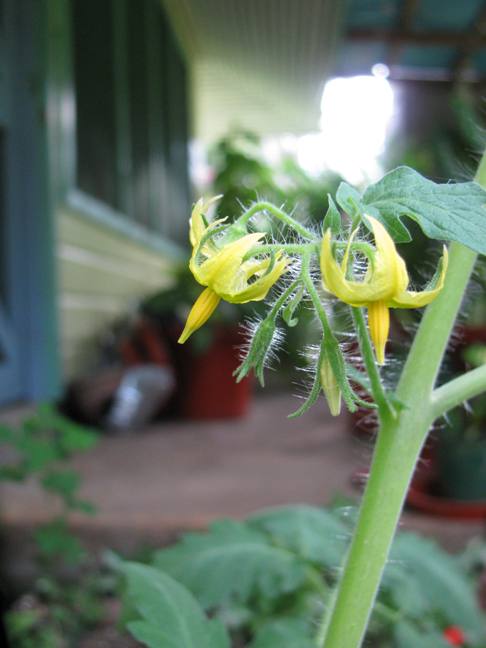
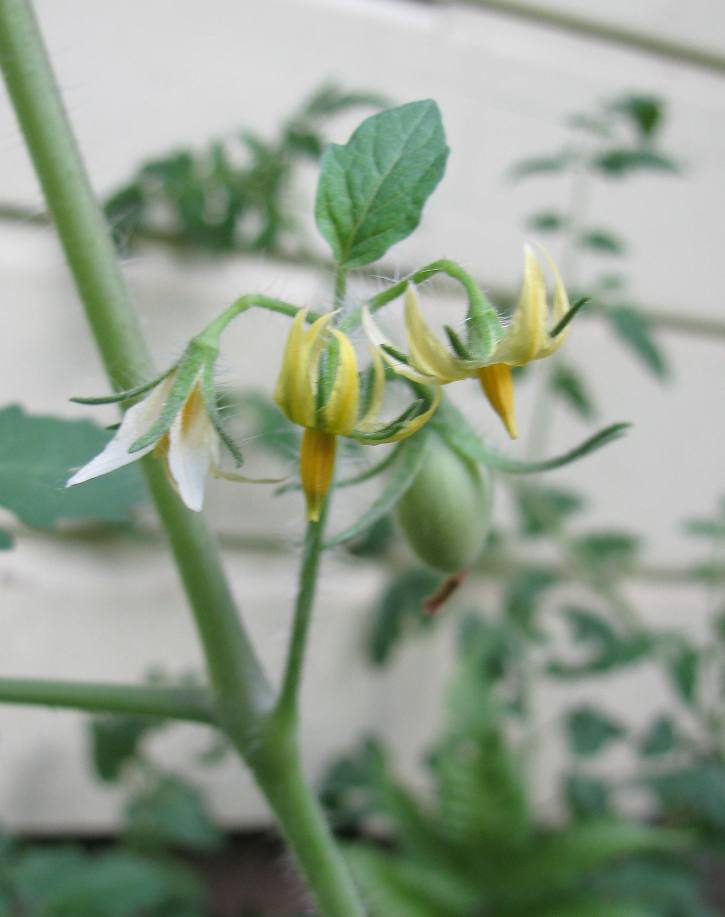
I took some pictures of the flowers because they look quite nice, not that they could ever end up in a flower shop or a flower bouquet since they are far too small. Still I think that their delicate simplicity and the fine hairs of the stalks and leave are quite interesting and came out reasonably well using the macro.


Its strange how you usually do not notice flowers of "edible" plants as being attractive ... well except for cherry blossoms and certain other fruit trees, but tomato flowers?